

Marketplace Fraud Is Becoming Agent-Led
Marketplaces have always been attractive targets for fraud.
They concentrate supply, demand, and transactions in one place, create economic incentives for participation, and depend on fast onboarding and low friction to grow.
Those same characteristics that make marketplaces successful also make them unusually vulnerable to abuse.
Most marketplace fraud comes from two sources: individual bad actors operating accounts manually, and automated bots executing scripted attacks at scale.
That model is beginning to change.
A growing share of marketplace abuse is becoming agent-led. These systems are coordinating activity across accounts, time, and workflows in pursuit of specific economic objectives.
This shift represents an important inflection point, making marketplaces natural testing grounds.
- Clear economic incentives: Promotions, referral programs, onboarding rewards, and supply subsidies create measurable value that can be captured if the system can be influenced.
- Multi-account ecosystems: Buyers, sellers, drivers, hosts, and guests interact repeatedly with one another. This creates opportunities for coordinated behavior to influence outcomes.
- Network effects: Adding friction can slow growth, so platforms often balance security improvements carefully against user experience.
- Journeys unfold across many steps: Account creation, onboarding, listing creation, transactions, payments, and reviews all occur over time and across different endpoints.

This complexity provides opportunities for experimentation and adaptation by automated systems pursuing economic goals.
Marketplaces Are Built for Liquidity
Marketplaces succeed when they can:
- attract more participants
- reduce friction for new users
- increase transaction volume
- make interactions easy and fast
To achieve this, they typically keep the early customer journey as accessible as possible.
Account creation is simple, verification is often gradual, and incentives encourage supply and demand growth. Trust systems such as ratings and reviews develop over time rather than being required upfront.
These design choices make marketplaces powerful growth engines, but they also create environments where identities, reputation, and participation signals evolve gradually.
That dynamic works when each participant represents an independent actor. When networks of coordinated accounts begin interacting with the platform, it’s a challenge.
Historically, most marketplace abuse followed relatively predictable patterns.
Fraud teams dealt with account farming, promotion abuse, referral loops, and reputation manipulation executed through simple automation or coordinated manual activity.
These attacks were often characterized by speed and repetition where large numbers of accounts appeared in short time windows, traffic patterns looked mechanical, and automation frameworks generated recognizable behavioral signatures.
Detection systems evolved around those signals.
Velocity limits, device fingerprints, and session-level scoring were effective because the automation looked fundamentally different from human activity.
Agent systems change that.
The Shift Toward Agent-Led Fraud
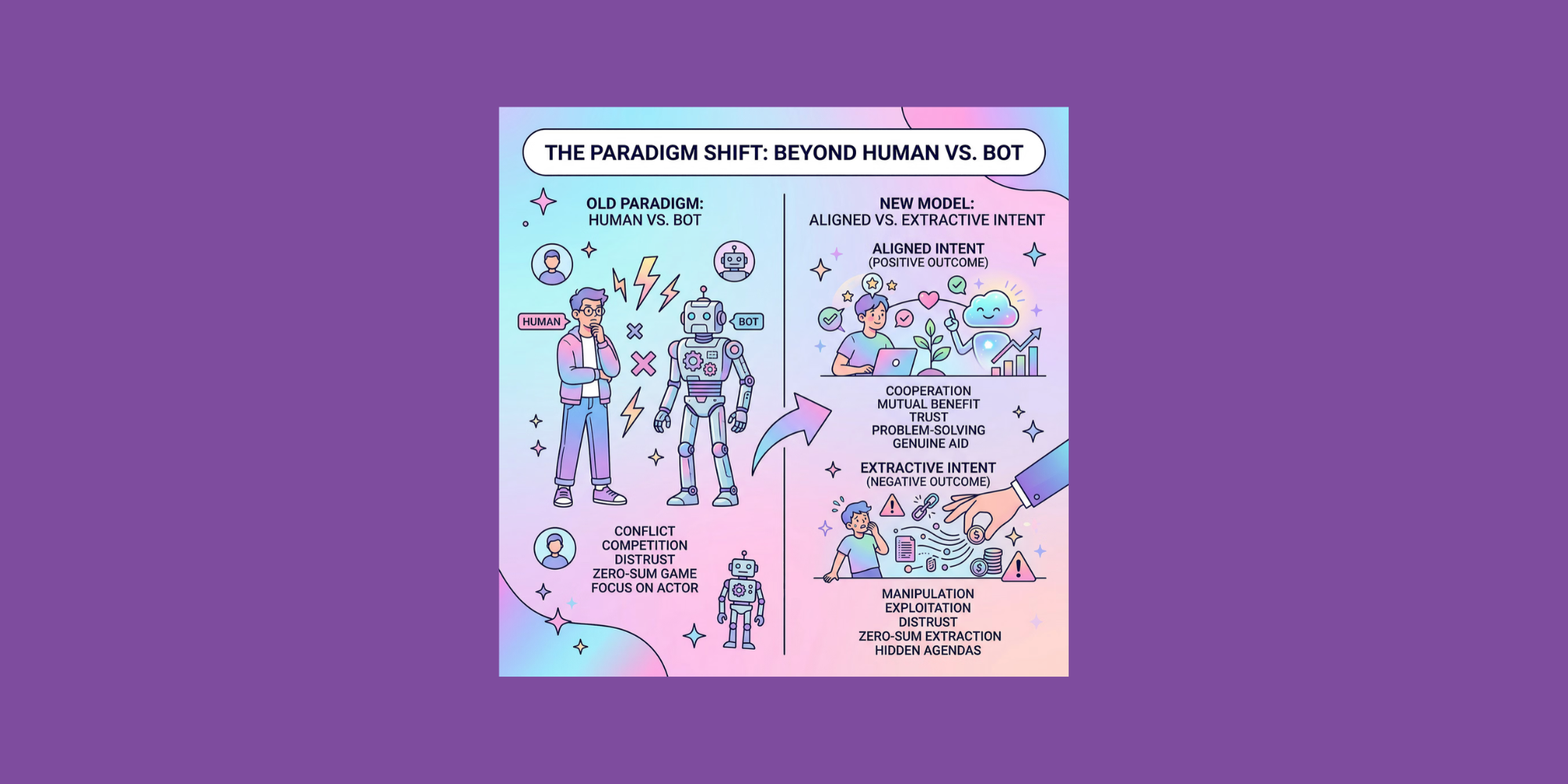
Agents behave differently from traditional bots.
Bots executed predefined scripts. They attempted the same action repeatedly until they succeeded or were blocked.
Agents behave more like systems exploring an environment.
They can observe how a marketplace responds to different interactions, adjust their behavior when friction appears, and distribute activity across time and identities. Instead of repeating the same action quickly, they can operate patiently, gradually building accounts, reputation signals, and transaction history.
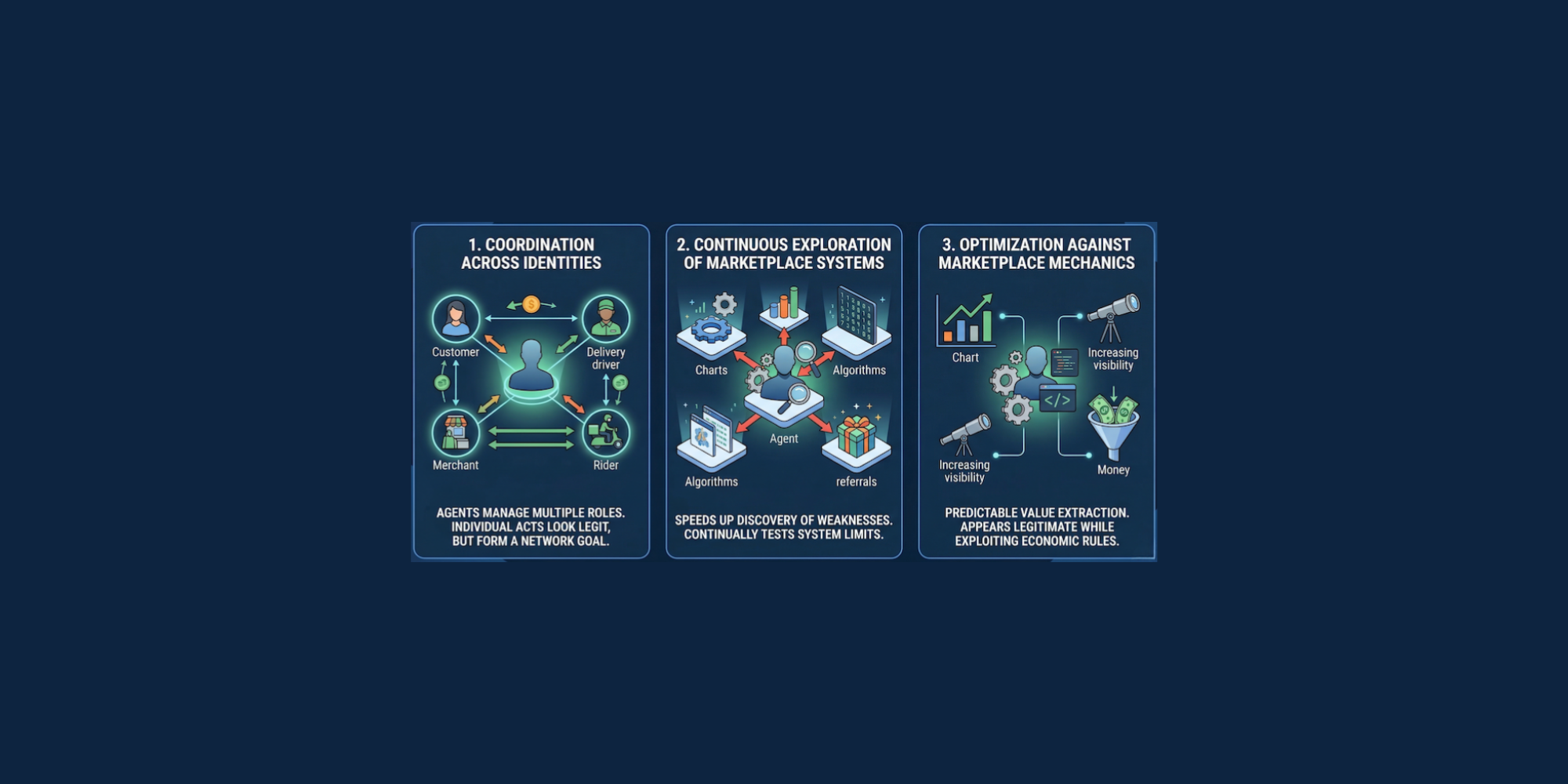
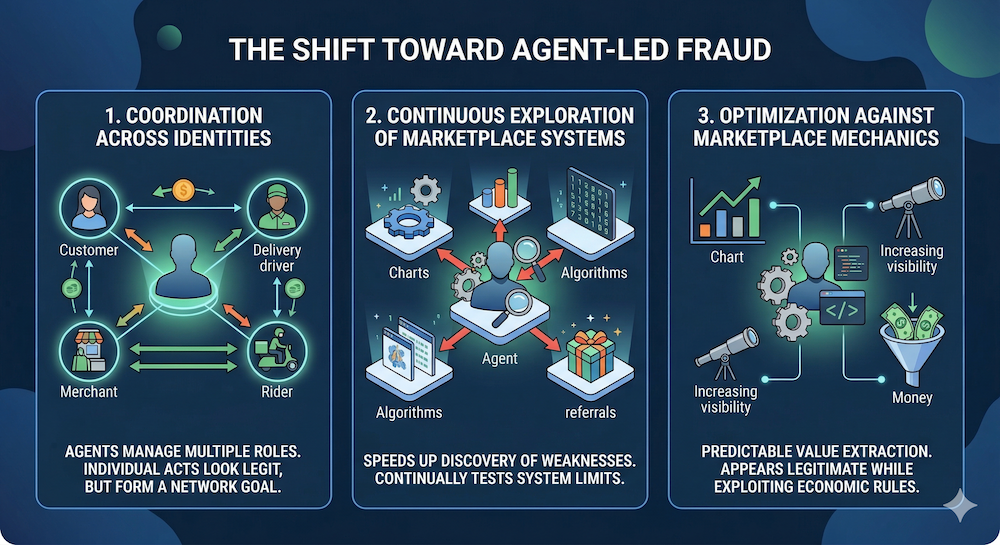
This creates three important shifts in how marketplace fraud appears.
Coordination Across Identities
Instead of a single fraudulent account, agents can manage networks of identities that interact with one another across the platform. Buyer and seller accounts, drivers and riders, hosts and guests, or merchants and customers can all participate in activity that looks legitimate when evaluated individually.
Viewed across the network, however, the accounts are working together toward a shared objective.
Continuous Exploration of Marketplace Systems
Agents also accelerate discovery.
Most marketplaces contain dozens of mechanisms that shape behavior: referral programs, onboarding incentives, ranking algorithms, pricing thresholds, and reputation systems.
Historically, attackers discovered weaknesses in these systems slowly through manual experimentation.
Agents can test these mechanics continuously. They can observe how many accounts can be created before friction appears, how incentives respond to different participation patterns, or how reputation signals influence rankings. As the system responds, the agent adapts its behavior.
Over time, this allows coordinated networks to discover which interactions produce the most reliable economic outcomes.
Optimization Against Marketplace Mechanics
Once agents understand how the platform behaves, they can begin operating in ways that consistently extract value from it.
Instead of exploiting a single vulnerability, the system begins interacting with the marketplace’s economic rules in a way that appears legitimate but produces predictable advantages.
This might involve capturing incentives designed to stimulate supply, influencing reputation signals that affect visibility, or interacting with pricing and ranking systems in ways that benefit coordinated accounts.
From the platform’s perspective, the activity often looks like normal participation. The difference only becomes visible when behavior is analyzed across identities, relationships, and journeys over time.
Where Marketplaces Are Beginning to See the Impact
Different marketplace models experience this shift in different ways. The underlying challenge, however, is consistent. Systems that were designed around independent participants must now detect coordinated activity.
Rideshare and Delivery Platforms
Driver marketplaces rely heavily on incentive programs to maintain supply during periods of high demand.
These programs often assume that each account represents a separate participant responding to the incentive structure. Coordinated networks challenge that assumption.
Fraud teams increasingly analyze how incentives are distributed across groups of accounts rather than focusing solely on single-account behavior. Patterns such as clusters of accounts participating in the same programs, shared infrastructure signals, or synchronized activity can reveal coordination.
Protecting these programs increasingly requires understanding relationships between participants, not just evaluating their individual activity.
E-Commerce Marketplaces
Product marketplaces rely on reputation systems to guide buyer decisions. Reviews, seller history, and engagement signals help determine which listings are trustworthy.
When those signals are influenced by coordinated networks, the platform’s discovery and ranking systems can become distorted.
To address this risk, many marketplaces are expanding their analysis beyond individual reviews or transactions. Teams look for clusters of interactions that reinforce one another, relationships between accounts that appear unusually connected, and patterns of feedback that indicate coordinated activity.
Maintaining trust in marketplace rankings increasingly depends on understanding how identities interact across the platform.
Ticketing Companies
Ticketing platforms have long dealt with automated purchasing, but coordinated systems introduce new dynamics.
Instead of relying solely on high-speed purchasing, coordinated networks can distribute activity across many accounts and time windows. This makes traditional velocity-based defenses less effective.
Operators are responding by analyzing purchasing patterns across groups of accounts, inventory flow between accounts, and resale behavior that indicates coordination.
The goal shifts from identifying fast transactions to understanding how groups of participants interact with inventory over time.
Accommodation Marketplaces
Trust systems are particularly important in accommodation marketplaces, where hosts and guests must feel confident interacting with one another.
Reviews, booking histories, and platform reputation are critical to establishing that trust.
Fraud teams increasingly monitor for signals that these trust mechanisms are being compromised. Clusters of interactions between hosts and guests, unusual patterns in review generation, and relationships between accounts can indicate coordinated networks attempting to influence reputation systems.
Strengthening identity persistence and visibility across participant interactions becomes central to protecting the platform.
What Marketplace Teams Can Do Now
Preparing for this shift does not necessarily require introducing heavy friction for users. Instead, it requires expanding how platforms understand identity and behavior.
Marketplaces should focus on three areas:
Understanding identity persistence
Look beyond individual sessions or devices to understand how participants behave across time and touchpoints.
Analyzing relationships between participants
Map connections between accounts, transactions, and infrastructure signals to reveal coordinated activity.
Evaluating behavior across journeys
Look at how identities interact with the platform over time rather than scoring isolated events.
These approaches allow marketplaces to surface coordination while preserving the low-friction experiences that drive growth.
Marketplaces Are the Early Warning System
Marketplaces were among the first digital businesses built around large-scale coordination between strangers. They’re also among the first places where coordinated agent activity is reshaping fraud.
The platforms that adapt their detection models early will preserve the economics and trust systems that make their ecosystems work.
Those that continue optimizing solely for the patterns of the bot era may find themselves defending against a problem that has already evolved.
Ready to get started with Spec?
Nate Kharrl, CEO and co-founder at Spec, has built leading solutions for application security and fraud challenges since the early days of the cloud era. Drawing from his cyber experience at Akamai, ThreatMetrix, and eBay, Nate helped found Spec to focus on the needs of businesses operating in a landscape of increasing AI risks. Under Nate’s leadership, Spec grew from its mid-pandemic founding to raise $30M in venture-backed funding to build solutions used by Fortune 500 companies transacting billions in online commerce. Spec’s service offerings today include protective measures for websites and APIs that specialize in defending against attacks designed to bypass bot defenses and risk assessment platforms.
Frequently Asked Questions


“With Spec, we can mitigate fraudulent activity, protect our revenue, and create a better user experience so that Indiegogo can remain a trusted crowdsourcing platform.”

Payments Manager
